
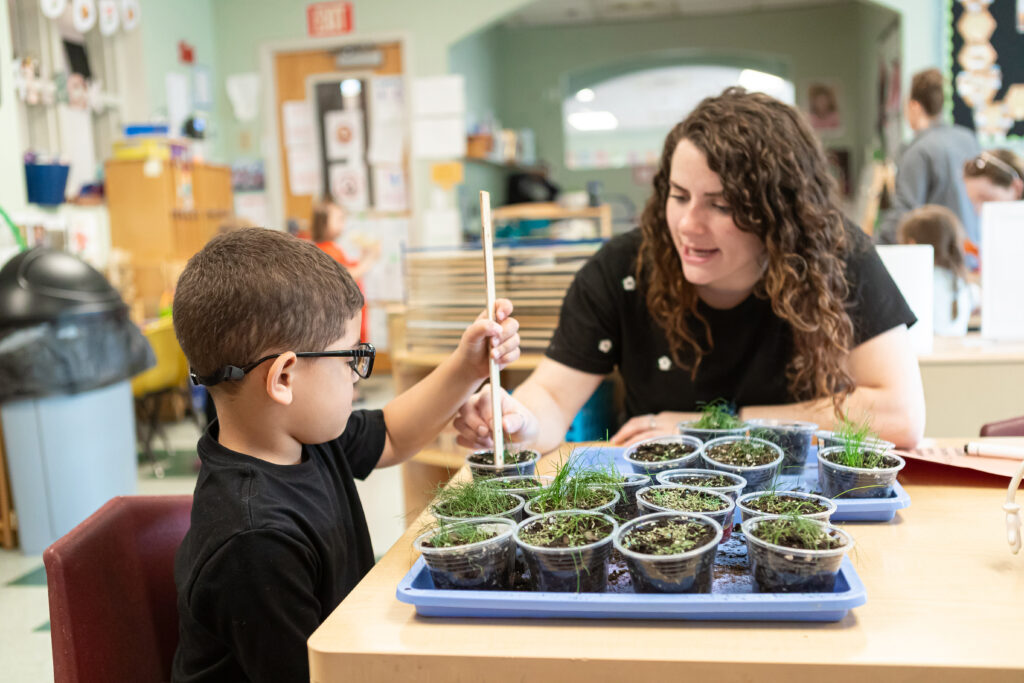
As a senior educational researcher, I’ve spent years studying how children learn and how teachers teach. One thing I know for certain: Research is most meaningful when researchers connect with teachers and students, when we get away from our offices and desks to more deeply understand the work occurring in real classrooms. Yet teachers face barriers to participating in research—it takes time from already busy schedules, and research can feel disconnected from daily practice. That’s why CAESART centers on strong partnerships with educators and school leaders to ensure that what we learn about science teaching in elementary classrooms represents real experiences that can then truly inform teaching and learning.
Why Classroom Research Matters
Educational research isn’t only about publishing papers on abstract theories; it’s about making a tangible difference in instruction and learning. When we study science instruction in classrooms, we’re working to answer questions that have real, practical implications: How can teachers embed science practices and make science more engaging? What instructional strategies help students grasp difficult concepts and learn how science builds knowledge? How can we fit high-quality science teaching into already packed school days? These questions are even more compelling in early elementary classrooms, where teachers face challenges in finding time to incorporate science into their lessons, and most children receive minimal science instruction.
Some teachers may feel unsettled by the possibility of inviting researchers into their classroom, especially when they don’t know what to expect. Teachers may wonder:
- Will researchers be evaluating my teaching performance?
- How much extra work will this create for me and my students?
- What will happen to the data collected in my classroom?
- Will this disrupt my regular teaching schedule and routines?
- How will my students react to having researchers in the classroom?
- What if the research findings make me look bad?
- Will I have any say in how the research is conducted?
- Will this research be useful for me and my students?
The challenges of research-practitioner partnerships are well-established, and these are all legitimate questions. Researchers have a responsibility to address these challenges by building trust and establishing meaningful collaborations.
Understanding the CAESART Research Approach
Just like instructional strategies for students, research strategies in schools and classrooms aren’t one-size-fits-all. We understand the demands of teaching and therefore rely on multiple strategies to get a complete picture of what’s happening in classrooms, with each method serving a specific purpose. We ensure that participation in research is practical for teachers by balancing the time required to participate, creates an open approach that is focused on learning across all classrooms and is not evaluative of individuals, and closely aligns with teachers’ successes, challenges, and instructional needs.
Here’s what teachers can expect from the methods we use:
- Surveys and instructional logs allow us to gather information from many teachers efficiently. Through carefully designed questionnaires, we can learn about your experiences and expertise, your teaching practices, your confidence in teaching science, the resources you have available, and the challenges you face. Surveys give us a broad view—they help us understand patterns and trends across multiple classrooms and schools. Instructional logs are quick, simple questionnaires, much like exit tickets that many teachers use with students. They help researchers understand more nuanced details of instructional practices closer to the time of implementation and enable us to link student learning with more specific practices. By documenting common challenges such as limited planning time or access to materials, results from surveys and instructional logs help ensure that professional learning and resources respond to teachers’ actual needs.
- Teacher interviews give us something surveys can’t: depth and nuance. In one-on-one conversations, we can learn more about your experiences, hear about specific successes and challenges, understand the ways in which you adapt curricula to the needs of your students, and explore the context that shapes your teaching decisions. These interviews are conversational and collaborative, not interrogations. They’re an opportunity for you to share your expertise and insights.
- Student assessments help us measure what students are actually learning. These aren’t high-stakes tests—they’re tools to help us understand how different instructional approaches affect student comprehension and engagement with science concepts. The goal isn’t to judge individual students or teachers but to identify which teaching strategies are most effective, as well as to identify strengths and weaknesses related to students’ understanding of science.
- Observations are typically conducted across 3–5 lessons. Researchers determine in advance which curriculum elements or instructional practices to look for and typically take a “fly on the wall” approach, with minimal interaction with the teacher or students. Observations can help researchers understand how curricula are implemented, how certain instructional practices are used, and how students respond to teachers’ practices. We understand that observations provide only a snapshot of teachers’ instruction. Therefore, observations are used to help illustrate findings revealed through other sources.
What We Hope to Learn—and How It Helps You
Each research strategy contributes something valuable. Together, these methods help us understand relationships between teaching and learning, leading to new strategies and curriculum materials for improved science instruction that actually works in real classroom settings. Teachers who partner with us can be assured that they are contributing to a large-scale, national research study. We’re not looking for theoretical concepts and we are not looking to evaluate individual teachers’ performance—rather, we’re looking for practical solutions that fit into teachers’ daily reality. CAESART researchers are interested in learning from a wide variety of teachers about common challenges and unique solutions, such as innovative approaches to assessments, ways of adapting curricula to student needs, or strategies to align science with literacy. Teachers’ and administrators’ perspectives and decision-making play a central role in shaping the questions we ask and how we interpret what we learn. Our research findings will directly inform professional development opportunities, curricular resources, and instructional strategies that you can use immediately. This isn’t research for its own sake; it’s research designed to give teachers better tools and approaches for teaching science effectively, to improve professional learning experiences, and ultimately to lead to more opportunities for children to learn science.
A Partnership, Not an Evaluation of Teachers’ Performance
Research in classrooms must be a partnership: We’re coming in to learn from you and with you. You are the experts in your classrooms, and we respect that expertise. Your insights not only strengthen the research but also help ensure that outcomes remain relevant, usable, and responsive to teachers’ and students’ needs. Our researchers look forward to collaborating with you to improve science teaching and enhance children’s science learning. We recognize that teaching is complex, demanding work, and we’re grateful for your willingness to open your classrooms to us. Your insights, your feedback, and your experiences are invaluable. Together, we can make science instruction more effective, more engaging, and more accessible for every elementary student.